
Navigation
Sidebar
fractured_planes
This is an old revision of the document!
Table of Contents
Overview
History
The histories below apply equally to most of the inhabited worlds as the gates allowed for easy travel and communication between worlds. Gaia is a world in this setting and is mentioned specifically at the end.
- Age of Gods - The Creator creates “everything”, including the Gods. The Gods then create the worlds and populate with beasts and mortals alike. Little is known of the era (including the truth of it), but tales abound of epic wars between good and evil, grand quests, and divine intervention. Eventually, the Gods left or fell silent.
- Age of Chaos - Now bereft of their creators, the remaining mortals were left with a vacuum of meaning and fell into violence. Not much is known of this age as the progress and knowledge attained previously by Gods and mortals were largely lost.
- Age of Rebirth - Eventually stories of the pantheons, the children of the Old Gods, returned a sense of purpose and quieted the chaos. The pantheons united each of the mortal races with themselves but also created barriers between neighboring races. The races, having previously lived in coexistence, split into their kingdoms. Of these, the humans, a formally minor species, began populating rapidly and gained prominence. While neither good or evil, humans fought the hardest for their independence from mixed coexistence.
- Age of Magic - Magic, the tools of the gods, were eventually picked up by mortals. Eventually, they grew to become masters of this magic, and stories speak of the wonders created during this age. The most powerful wizards were thought to have approached “god-hood” themselves. They created a mage-ocracy which those being trained in magic ruling over and protecting for those who didn't. However, these magic practitioners became obsessed with their own pursuits, consolidated their own power, and began to refuse to share their abilities with the world. As the divide between the two castes (magic and nonmagic) grew to staggering heights, revolts around the world broke out, often led by religious zealots who decried the corrupt nature of the wizards who had the audacity to claim to be gods. The wizards used magic to protect themselves and killed many. This had only served to rile the masses more, and eventually, the wizards of old were overthrown and magic forbidden throughout the known world. Around the end of the Age of Magic, the Gatekeepers began closing many of the gates to other worlds, including those of Gaia. As the knowledge of magic (and subsequently gates) were being intentionally destroyed at the time, Gaia is largely ignorant of the other worlds.
- Age of Kingdoms (in Gaia) - After the fall of magic, centralized governments grew to replace the mage-ocracy. These kingdoms were unified often based on race, geography, religion, and other beliefs. Over the centuries, kingdoms rose and fell due to famine, war, and consolidation. Humans continued to remain somewhat apart from the other races but never to an extreme level. At least not until the Church of Flame, one of the first monotheistic religions, preached a human-first dogma.
- Modern Age (in Gaia) - While arguably not an age in its own rights, the modern age is characterized by the rise in trade and the technology that enables it. Notable among the kingdoms is a loose collection of city states (the Free Cities) that are governed by committees of wealthy merchant families. In part due to their geographic location between several wealthy kingdoms, their acceptance of anyone despite race/creed/religion as long as they have coin, and their embracing of Artificery, the Free Cities are rapidly generating wealth but also attracting the attention of the rest of the world.
The worlds
The Gods didn't create just one world, they created many. Across these worlds, they created many plants, beasts and eventually mortals. To connect these worlds for their creations, they built a series of permanent gates (or portals). For a long time, there was no barrier on these gates and anyone who attempted to block a gate risked the wrath of the Gods.
As time progressed, the Gods periodically fought, and one consequence of this, weak points between the worlds were created. The larger weak points quickly tore into a hole to an adjacent world, but the gate's were unstable. The Gods closed most of these, but some of the smaller or less fragile weak points were missed. Over time, these weak points grew to become chaotic gates between worlds, and the Gods closed those that appeared.
After the Gods disappeared however, the weak points continued to tear into chaotic gates. The Elders, the 1st race of Gods, took it upon themselves to close these gates if they were a danger or open them fully if they were useful. After a time, they delegated this work to the Gatekeepers. After the Gatekeepers split from the Elders employ, these gates were thought a liability, especially to balanced worlds, and were shut down in the name of protecting from the Unbalancing.
The Unbalancing
After the Gods left the worlds, the worlds very slowly began to stop working correctly. In some worlds, the sun would dim and eventually stop shining. In others, extreme weather and climates (storms, ice ages, drying of a planet, loss of atmosphere, etc) would take over. In some cases, the orbits of celestial bodies planets would destabilize, causing asteroids to smash into planets to for planets to be ejected far from the warmth of its sun. When conditions became incredibly severe, these world's would eventually collapse, and the gates to neighboring worlds would stop functioning entirely, often in such a way as to cause much damage in the neighboring worlds.
Worse than this, when one world became “unbalanced” and began to fail, it's unbalancing would eventually spread to its neighbors. Therefore, world after world sicked and collapsed. Refugees fleeing their failing worlds would flee into neighboring worlds. This caused tension between these groups of peoples, but the Elders (and later the Gatekeepers) kept a degree of peace allowed for the flow of refugees. However, the Unbalancing continued to spread over the millennia and nothing seemed to be able to stop it.
The Elders, the 1st race of the Gods, took on countering the unbalancing as their race's mission and began dedicating all of their resources to stopping. The Elders found that they could slow the Unbalancing but could not stop t. Research continued, and time raced on. Unfortunately, the Elders, despite their power, were slowly dying off, and in their eyes, the lesser races were of a limited ability to assist. The Elders did not quit, and delegated much of their ancillary work to the lesser races (such as the Gatekeepers) so they would better focus. Most of their ideas failed to work, but a few had the potential to save everything. They just needed more time.
The Gatekeepers (see faction info below for more detail) grew to believe that allowing travel between an unlabanced world to a balanced world was contributing to the spread of the unbalancing. They began to limit and eventually ban all unofficial travel to balanced worlds, but this limited the ability of refugees to flee as well. This put them at odds with the Elders who had assigned them in part to protect refugees. However, the Gatekeepers continued to do most of their other assigned functions, and the weakening Elders decided to not directly appose their now former employees.
Gaia, one of the remaining stable worlds, was cutoff from the remaining worlds by the Gatekeepers around the time of the end of Age of Magic. (Aside: Some historians believe that the Gatekeepers encouraged this collapse because Wizards were frequent planewalkers, but there is no substantial proof to back this.) Much of the knowledge of the worlds was tied into magical knowledge and therefore intentionally expunged from written record in Gaia. The end result is that Gaia has almost no knowledge of worlds outside theirs, the factions that move between the worlds, and even the Unbalancing.
Magic
Most religions/histories agree that magic is the tools of the Gods that the Gods have allowed (intentionally or otherwise) mortals to use. After the (mythical) Age of Gods, the mortal races embraced magic to protect themselves from many of the dangers in the world. Over the centuries, they mastered the arts. However, the magic practitioners consolidated their knowledge and stopped sharing with their brethren, and this lead to stark class system based on one's access to magic. Many people suffered during this time. Most religions and many histories argue that the magic also corrupted the users and made them evil. Protests eventually overthrew those at the top, magic was banned throughout the world, and the Age of Magic ended. For long after this period, those found practicing magic were subjected to some of the harshest punishments imaginable.
Despite this, the practice of magic continues throughout the world albeit mostly in secret. Those who practice magic tend to fall into one of the following:
- True magic users - Every mortal is believed to be able to practice magic should they learn in a “correct and balanced” way. These users often progress very slowly but have a breadth to their abilities that no other can claim. It's not clear if the slow pace is due to the limits of mortals or that the modern understanding of magic is at fault. High magic users typically practice their arts in remote corners of the world and are careful about revealing their abilities should they choose to travel the lands of non-magical. There are rumors of High magic practitioners who eventually attain “god-like” powers, but this is largely discounted.
- Wild magic - Many people stumble into magic accidentally at a young age (less frequently later in life). If they choose to pursue their abilities (and aren't killed by the numerous anti-magic factions), they typically very rapidly learn a nuanced path of magic but find themselves unable to learn anything outside their specialty. Sub-disciplines include: diviners, shamans, pyromancers, shapeshifters, mind readers, etc. Teaching these sub-disciplines is often difficult as the path of each practitioner is often fairly unique. Because of this, teachers of wild magic often refer to themselves as Guides.
- Divine magic - Magical scholars (those who are allowed to continue their work) secretly consider divine magic to be a subdiscipline of true magic, but because most religions vehemently denounce true magic, it is very dangerous to speak these ideas aloud. Many religions allow a select few of their flock to practice divine magic in name of their god/gods. This grants them access to magic that closely aligns with their beliefs and no other magic is allowed. Despite this form of magic being condoned by various religions, is typical that most regions harbor a distrust (if not fear and hatred) for their divine magic practioners.
- Artificers - Somewhat recently, the art of artificery (binding magic to physical items to perform specific tasks) has become partially accepted, particularly in the Free Cities where they see the benefits of it for commerce. The typical explanation that sets Artificers apart from True Magic users is that they don't truly use magic. Instead, they bind the magic to items without internalizing it, and therefore are free of its corrupting influence. There are many heated arguments about this topic around the world (particularly in religious circles), but Artificers are growing in acceptance. Within the last decade, practicing Artificers have created the Artificer's Guild both for protection of its members and also to protect the its intellectual property and therefore increasing their worth. The Guild also limits the spread of Artificery for fear that spreading too quick will result in a severe backlash. While their efforts appear to be working, the “closed off” approach also reminds everyone of the Age of Magic, and even Artificers in the Free Cities have to be careful walking alone at night. Because of this and also the bullish tactics of the Guild, it's rare to find an Artificer that is not a member of the Guild.
Countries/Regions
This setting has multiple levels. The highest level are a collection of worlds that were created by the Gods. The world, Gaia, one world among many and is the focus of this setting. Finally, one corner of Gaia (presently nameless) is the focused region of Gaia and is described below.
- 5 eastern nations - Forests, grasslands, hills, coastal. Factious but (recently) loosely bound by the Church of the Flame. Predominantly human and somewhat intolerant to other races/religions/etc.
- Northern expanse - Untamed lands. Mostly cold hills and tundra. Barbarians, nomads, tribes. Raiders. Deemed a moderate threat to neighboring realms. However, the land isn't very valuable due to climate.
- Western “wildlands” - Forests, jungles, mountains. Predominantly non-human. Home of the some of the largest non-human kingdoms.
- Free cities - Notable river, arid plains, rocky terrain. South of wildlands and west of eastern nations. Demographically diverse. Run by merchant families. Trade mecca between the 5 nations, the wildlands, the southern empire, and the far-western kingdoms.
- Farwestern kingdoms - Far to the west of the Free cities, across a large desert, are several exotic kingdoms. Trade with these kingdoms is both dangerous and lucrative.
- Southern empire - Very large kingdom spanning many different climates/biomes. Mostly human but some diversity. The major power is this part of the world. Separated from the north by the blue sea. Strong culture and military. The country is caught up in a political war with a nation to its south. However, the growing wealth of its northern neighbors draws ever more attention.
- The barrens - A great desert spanning between the free cities and the farwestern kingdoms. Several trade routes span the barrens connect the two regions. However, the way is very dangerous and stories of demons, serpents, raiders abound.
- The blue sea - Large sea that separates the Southern empire. The Sea connects the Southern Empire, Fre cities and 5 kingdoms.
- The Western ocean - Large ocean to the west of the 5 kingdoms and southern empire.
Religions (Gaia)
- Church of the Flame
- Holds 5 kingdoms together enough to resist raiders from the northern expanse and minor Southern empire incursions
- Sun god - monotheism (mostly)
- Beliefs focus on a divine god of flame who scoured the world free of evil with its flame
- The sun god (need name) spends half of its time in the mortal world protecting its followers from evil (day time) and half its time (doing something else) (night time)
- Promotes purifying pagans with fire (but not often practised)
- Human-centric
- Strongly antimagic
- Divine magic is allowed by a certain branch of priests. However, this branch is shunned and feared by many, including from the church itself
- Old gods
- Largely fallen out of practice. Believes that the old gods created the world and have largely gone silent. However, they occasionally visit the world and answer the prayers of their followers.
- Misc. pantheons
- Each race has its own pantheon that it worships. These pantheons are aware of the other pantheons. These pantheons sometimes helps its people and sometimes uses them for their own pleasures and purposes. It is often believed that these pantheons are the children of the Old gods, left behind after the Old gods disappeared.
- The Elements
- Dominant religion (belief) in the Southern empire
- Elements are wild spirits that inhabit raw materials in the world and sometimes interact with humans (in both good and bad ways)
- Elements are real (people actually encounter them) but not obviously sentient. Worshipers of the elements believe that worhshiping these spirits bring good fortune. The spirits are largely ignored by non-followers or viewed as curiosities.
- There are many elemental types, and worshipers follow the philosophies of a particular elemental type, often for decades. This often influences their path (occupation, etc) in life.
- It is common practice for followers to change their focus across several elements throughout their life. Changing too often or not enough is frowned upon.
- Each elemental type (typically inhabit raw materials) has an associated philosophy
- Iron - Militaristic. Aggression, protecting loved ones, etc.
- Gold - Ambition. Trade, political power.
- Soil - Growth. Farming, family, etc.
- Wood - Creativity. Craftspeople, construction, etc.
- Water - Exploration. Knowledge, exploration, travel, etc.
- and more…
Notable factions (Gaia)
- Church of the Flame (Gaia only)- see Religions above
- Sweepers (Gaia only) - “grassroot” movement in many parts of the world that strongly hates magic users. They see that the world is loosening its restrictions on magic users, and they believe that they must correct this. They often hunt down anyone accused of using magic, “test” them, and hassle, drive off, and sometimes kill anyone found guilty. Many parts of the world, particularly the Church of the Flame, choose to look the other way or provide mild punishment on Sweeper's actions. In the Free Cities, Sweepers often target Artificers, but the Cities crack down on this harshly when possible (the Artificers are important from commerce even if they are slightly distasteful). The Cities are much less protective of other forms of magic users.
- Artificer's Guild (Gaia only)- While still small, the Guild formed to protect Artificers from the prejudices of the outside world as well as to create a monopoly on sanctioned magic (although the term “magic” is strongly discouraged by its members). The Guild works closely with the Free Cities and the merchant families that run them for mutual economic benefit but also because the Free Cities has promised to protect the Guild. This arrangement, however, requires that the Guild not abuse their monopoly as it applies to the Cities. Admission to the guild is based on admission fees (the wealthy are far more likely to join) as well as rigorous testing. Progression up the Guild's ranks grants its members more wealth, knowledge, and responsibility at the cost of being kept on a shorter leash. The Guild keeps its secrets close and actively discourages free-lance Artificers.
- The Council of _ (“The Council”) (Gaia only) - A loose alliance of the races. Uses their limited influence and backdoor channels to keep the non-human races unified in the face of humanism. Some claiming affiliation with the Council have targeted humans in violent methods, but these groups are disowned by the Council. Human factions, at least those without human-first agendas, often have a presence of the Council. ====== Notable factions (throughout the worlds) ====== * The Elders - The existence of the Elders is known by only a few. The first race of peoples created by the Old Gods. Also called the people of the 1st world. Are believed to be giants of immense power but are believed to be mostly extinct by knowledgeable scholars. Commoners who have heard the term think them to be a legend. In truth, the Elders are very few in number, but are driven by their loyalty to the Old Gods. Specifically, they wish to correct the Unbalancing of the worlds. They control many influential leaders across the worlds to persue their agenda of seeking Balance. When diplomacy and bribery fails, they are believed to employ a small force a planewalkers to commit assassinations and by apply other relevant strategic leverage as needed. * The Immortals - The existence of the Immortals are not widely known and often believed to be a myth. The prominent theory of their existence among scholars is that the immortals were first created by the Old Gods because each time the Gods approached the mortals, many generations of mortals had passed and the nuances of speaking with the Gods were lost. Therefore, the Gods arranged it so that very infrequently, a mortal was born to each race that would never die. The immortal mortals (called Immortals) became the envoy of the Gods during the age of Gods. After the Gods disappeared, the Immortals continued to be created but no longer had a purpose. Immortality also turned out to be both a blessing and a curse. Many immortals, faced with infinity and the accumulated mental trauma across millennia, became mad. As immortals are not common knowledge in the modern era despite being continually born, it is believed that the Immortals must be able to die or be killed in some way. Many scholars argue that Immortals are the source of the legends of the pantheons but this is highly disputed. Immortals are also believed to be major power players in various organizations around the world but remain out of sight. It is believed that they choose to remain in myth because many of them likely rely on magic and their immortality is attributed to magic. King Azamar the Bloodthirsty, leader of the largest northern barbarian tribe, is speculated to be an immortal. * Gatekeepers - * Previously unknown in Gaia until their recent actions. The Elders, while working on solving the Unbalancing, created an organization to protect the borders between the worlds. Orignally, their responsibilities including 1) allowing for the safe passage of peaceful refugees fleeing the unbalancing, 2) keeping chaotic factions from freely moving between worlds and sewing chaos, 3) closing gates to failing worlds before the end of each, and 4) acting as a standing army for the Elders in times of need. The gatekeepers, a collection of all the races (except the Elders), served in this capacity for many millennia. * Some time ago (coincidentally coinciding with the Age of Magic on Gaia), the Gatekeeper leadership decided that the Unbalancing was spread between worlds not by the existance of doors between worlds, but by active travel between worlds. The Elders rebutted this position, but the Gatekeepers held fast to their beliefs. Because of this, the gatekeepers began shutting down or blocking portals to worlds that had not yet been affected by the unbalancing. This included prohibiting refugees to travel to these worlds (which was a violation of their first tentant). As strain grew between the Elders and Gatekeepers, the Gatekeepers eventually split away from the Elders. The Elders, overwhelmed by the enormity of stopping the unbalancing, weren't willing to commit the resources to shutting down the Gatekeepers. Instead, the Elders allowed the Gatekeepers to continue in their new role as their interests still “mostly” aligned. * The gatekeepers tenants now are 1) Prevent all travel (excluding officially sanctioned) to and from worlds that are considered stable 2) allow refugees to freely travel between unstable worlds but not to stable worlds, 3) keeping chaotic factions from freely moving between worlds and spreading their influence, 4) closing the gates to failing worlds well before each fails to prevent possible chain reactions, and 5) keep the existence of gates a secret in stable worlds to prevent exploitation and travel to/from unbalanced worlds. * Some 40 years ago, the new gates in Gaia opened by chance along a small way post on the trade route across the Barrens. While many explorers through the gates never returned, tales of new worlds full of wealth spread throughout the nearby Free Cities. Largely due to greed, the merchant families quickly established a presence there and then heavily reinforced it due to internal strife. Their reinforcement was fortunate as a contingent of Gatekeepers, only a few months late, arrived at the gate to shut it down. While each gatekeeper was much the better fighter than the merchants' mercenaries, numbers were against them, and they were rebuffed. A much larger force returned a few months later, but the city of Myst was formally established and heavily reinforced to protect the gate, known as the Ryft. While the return on investment from the Ryft has been only slight, the Artificers have recently developed an ability to better use the chaotic gates, and the potential for wealth grows ever higher. The merchant families have no desire to ever let Ryft be closed. ====== Foes (everywhere) ====== There are many factions that will move against our protagonists. However, most of them are not evil, acting out of a desire to hurt, or killing millions. That's not to say that such Foes don't exist. Non-sentient * The unbalancing (see above) - Destroys worlds and causes refugee crises. Not sentient. An unfortunate fact of life in the worlds. * War/tensions - There is tension between every faction, big or small. Sometimes this tension is righteous, sometimes selfish, and more often both. Often, this tension manifests into war, and this always causes hardship no matter the intentions. Sentient * Necromancers - As many worlds are destroyed and become uninhabitable, the Gatekeepers prematurely close off the gates from the most unbalanced. Those who are left behind raise their hands in anger at being abandoned but succumbed to their fate. One notable exception was a powerful wizard from a smaller world. This wizard, previously ostracized for her association with magic, offered her people a way to survive as the temperature of their world increased. This wizard was a necromancer, and specialized in sustaining life paradoxically through death. A few of the people of the world accepted the offer, and became sentient undead. This allowed them to survive the heat and loss of water on their world. Those who did not wish to follow, were turned to mindless undead to serve as labor. Even though necromancy allowed for the survival of a few, the world would eventually end. Fortunately, a chaotic gate was discovered in time, and the survivors fled their world to the next. In the next world, this necromancy threat, perhaps the most vile form of an already shunned magic, was attacked immediately by the living. The necromancers were forced to flee to unbalanced worlds that no mortal would choose to live in. And necromancy spread this way, living on the edge between the semi-stable mortal worlds and the collapsing unbalanced worlds. And it grew. Now the necromancers are a prominent presence among the worlds and no longer need to live on the edge. The are apposed by the Gatekeepers and most other mortal factions, but they can no longer be ignored. Their agenda is to prepare all of the worlds for the unbalancing by the only means they know how, necromancy. They have also grown to despise the living with a frequently irrational hatred and no longer mind the harm they cause to the living. * The Imprisoned One - One of the old Gods was left behind when the others disappeared. This particular god didn't play well with others and had been imprisoned. After the Gods left and the Unbalancing started, the Imprisoned One gained a modicum of control outside it's prison. It's goal is to be released before everything collapses to the Unbalancing and is willing to do anything to achieve this. Mortals and beasts are manipulated into serving the Imprisoned One and work to free their God. ====== The Free Cities (Gaia) ======
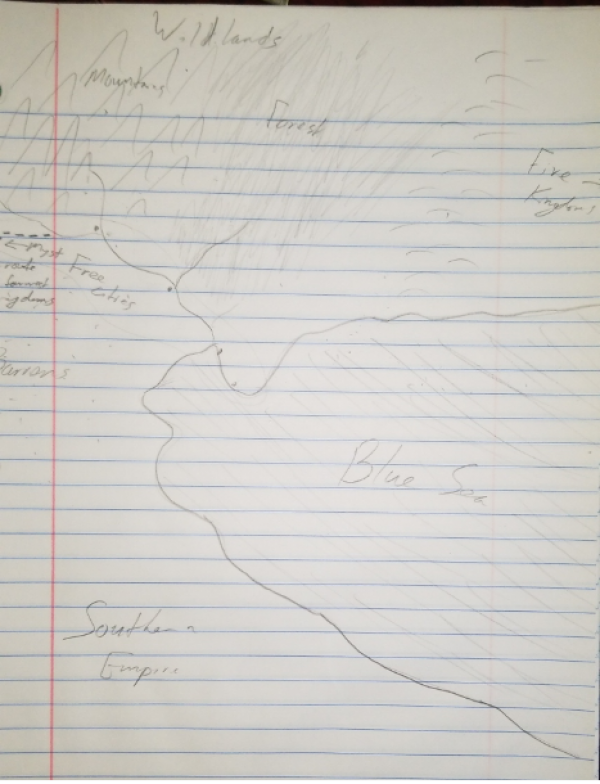 Geography: The southern reaches is an arhipelogo covered by swamps. Further north, a river runs northwest boarding the Wildlands (home to many beasts as well as races not always friendly to humans). To the west lies arid land that leads into the Barrens. The river continues further north into the mountains, ruled by more beasts and non-human races. Westward of this point lies a trading path across the Barrens to the faswestern kingdoms. The trail is dangerous but lucrative.
History: Long before the Free Cities, this land was a true wildlands, occupied by beasts and wild races. The land was poorly suited for agriculture, surrounded by dangerous wildlands (swamps, forests, mountains, deserts), and therefore largely ignored by the civilized lands for a long time. Eventually, they moved in and waged war on the lands in an effort to domesticate them but mostly failed. The most successful attempt was the human kingdom of _ expanding from the south, but they too eventually withdrew their claim to the land. But a small trading and fur-trapping presence remained behind. These traders provided trading opportunities between the mostly human lands to the east and south to the feral wild lands and non-human kingdoms to the north. A trade route across the barrens was also discovered and brought with it a trickle of wealth from the farwest. As stability came to the surroundings lands, trade grew, and the area became more established. Raiders and pirates began targeting the trade through these lands but many eventually became traders as it proved to be more profitable. Unrest in neighboring lands and a desire for money and a new life drove both humans and non-humans alike to these lands, and the populations swelled. A number of trading companies, each run by a hierarchical family, grew to prominence, and decided to organize the growing trading towns into a collection of city states called the Free Cities.

Until Myst, there were four primary city states in the Free Cities. From south to north, they were Clusas, Veritas, Pragos, and Lophia. Because these settlements were originally trading outposts run by trading companies, the prominent trading families decided that each city should be a plutocracy run by those who had the most to gain from it (i.e. themselves) and was therefore the most invested in the cities outcome. Each city was setup to be run by a committee of the most prominent merchant families. A seat on each city's committee (and therefore voting rights) required a notable contribution of money to the city which allowed the city to invest in itself and continue to grow. At first, each city was run by 5 to 10 families each, with a few families holding positions in multiple cities. As the wealth of the region increased, the number of seats grew until each city placed a cap on the number. The governmental styles of each city continued to grow in different directions, but all four share the same roots.
The southern most city of Clusas was the least prominent of the four. While the closest port to the human lands, it was probably the most poorly chosen location. It was placed inland a few miles up a small river to prevent flooding. However, mosquitos and disease from the swamps swept through from time to time, and raiders from the north and east raided the settlements heavily in the early years. Pirates operating with the Blue Sea were more prominent in this area and could easily block the narrow shipping lanes through the swamps. With a partial bailout from the other Cities, Clusas invested in a number of mercenary companies which setup shop there and eventually repelled many of bandits in the area. In addition to being an important trade hub, Clusas is known for its hospitals, breweries, and mercenary companies.
Farther north, the City of Veritas was also built on a series of 4 rocky islands among the swamps. While Mosquitos and disease were similarly rampant, the city was protected from land-based raiding parties by being on islands, and the city maintained a reasonable naval presence to prevent significant losses to pirates. The city struggled with flooding during the early years but a series of canals were built throughout the city to manage the water. In addition to being an important trade hub, Veritas is known for its boatyards, glassblowing, and universities.
The third city was Pragos. It was located inland, up the _ river and at the fork with the _ tributary. The _ running northwest was a major trade route and the tributary running north east allowed for convenient trade into the wild forests of _. The city was located on the west bank of the river which offered it a fair amount of protection from wilds to the east. Bandits from the eastern Barrens did venture into the area from time to time, but never grew root. Pragos was perhaps the most successful of the Free Cities in terms of wealth and growth. Because of its success and being centrally located, Pragos is often the meeting area when the Free Cities discuss trade and policy between themselves and when the Free Cities need to be unified against the outside world. In addition to being an important trade hub, Pragos is known for its lumber, pottery, tourism for “wild” hunting, and culinary cuisines. It has also become the headquarters for the Artificer's guild.
The fourth city was Lophia. It was located further up the _ river and in the foothills of the _ mountains. It also marked the end of the navigable portion of the river and where trade needed to continue by cart. Because of the proximity with many of the cave dwelling races in the mountains, Lophia became known for metal forges and jewelry craftspeople. Due to religious persecution from the Church of the Flame, it has also become a sanctuary for many religious types. Before Myst, it was the last major trading station across the Barrens to the fareast.
The fifth and by far more recent city is Myst (see below for more detail). Myst was formally a minor trading station at the edge of the Barrens and along the route to the fareast. With the discovery of a temperamental network of cross-planar gates (the Ryft), the potential for wealth was immediately recognized when early explorers returned with riches from uncharted lands. Myst derives its name from the gut churhing myst that periodically spills forth from the Ryft and swallows part of the city. Myst is heavily defended at present to protect the gates from a mysterious faction called the Gatekeepers that demand that they be allowed to shut the gates. Myst is known almost exclusively for the Ryft, and the riches (including strange artifacts) that come from the other side of the gates.
The Free City, Myst (Gaia)
Ryft (Gaia)
fractured_planes.1621112583.txt.gz · Last modified: 2021/05/15 21:03 by admin


